
Official 2026 game trailer
Factorio — Trailer 2026
Source: Factorio (official game channel; Wube Software).

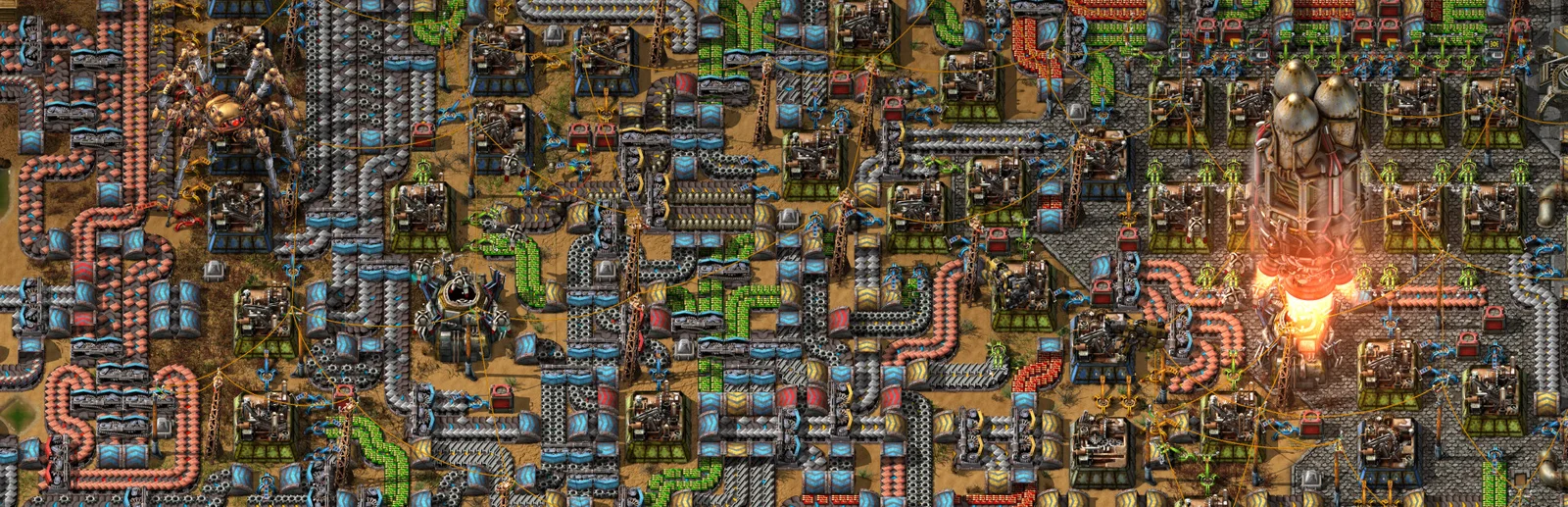
Mine resources, automate machines and keep expanding an increasingly complex industrial network.
PlayNorio / from the source
Hand-picked videos matched to this exact title or edition. Third-party playback starts only after you select Play; official evidence is linked below.
1 publisher-attributed video · Playback availability varies
Official 2026 game trailer
Source: Factorio (official game channel; Wube Software).
PlayNorio is independent and not affiliated with the video creator. Embedding and playback availability are controlled by the video owner and YouTube. A trailer or teaser is not necessarily unedited gameplay.
Factorio begins with a simple survival need and quickly becomes a detailed simulation of automation. Mining machines feed furnaces; furnaces feed assemblers; assemblers make parts that allow yet more machines to exist. What distinguishes it is the precision of the underlying systems. Every belt, inserter and train schedule can be designed, measured and improved. As your factory grows, defending it and managing pollution add further pressures. The game encourages players to think of a production line as a system that can evolve rather than a puzzle with only one correct solution.
Open an image for a closer look. Source and edition details are linked below each image.
Images belong to their respective rights holders. Commercial reuse review is pending.
Belt throughput, machine speed and resource demands determine whether a line operates efficiently. Electricity, oil processing, circuit networks and trains add successive layers of complexity. Players can automate research, equipment manufacturing and even construction itself with robotic logistics. The map gives room to spread out, but growth creates long-distance transport challenges. Cooperative multiplayer and an extensive mod ecosystem offer different ways to approach the same underlying problems.
Get basic iron and copper processing stable before trying to perfect a giant base. Keep factories modular, with enough space for future upgrades. When production slows, trace one missing ingredient backwards rather than rebuilding the whole chain. Trains become easier to manage once junctions and signalling follow consistent rules.
Factorio is an exercise in turning manual work into reliable automation. Raw ore becomes plates, plates become components and increasingly complex products feed research and expansion. Early conveyor lines and inserters introduce the logic of throughput. If a factory stops, trace the flow from raw materials to finished item to discover where the chain has been interrupted.
As production grows, train networks, oil processing and circuit systems offer new planning possibilities. Depending on game settings, pollution can influence the threat from nearby enemies, so defence may need to grow with the factory. A good layout is one that can be understood and extended, not simply one that looks perfectly symmetrical. Use the map and production statistics to locate problems.
Spoiler-light, game-specific starting advice: learn the most important systems, set meaningful goals and know what to practise next.
Start by creating one reliable supply chain from raw materials to a useful product, even if the arrangement is untidy. Being able to inspect the bottleneck is more valuable than drawing a perfect factory blueprint before the first machine works.
Production ratios, transport throughput and power demand interact. Watch a belt or assembler over time to see whether it is waiting for input, output space or energy, then fix the actual constraint instead of doubling the whole line.
A neat factory can become brittle if you optimise too early. Decide which lines must be dependable, which experiments can be temporary and how much room to leave for science, logistics and later redesign.
Pick one item that is always in short supply and trace it backwards through its ingredients. Improve the slowest link, then watch whether the next bottleneck appears elsewhere before expanding again.
Independent editorial guidance based on the existing PlayNorio game profile. Not a walkthrough for a specific update, and not a substitute for publisher information or verified media rights.
Explore the rest of this game guidePLAYNORIO / PRACTICAL FIELD NOTES
Factorio makes systems thinking visible. Begin with a small goal such as automatically producing a component used in research. Follow each ingredient backwards to its source and notice where an assembler waits for materials, power or an output destination.
Rather than rebuilding the entire factory whenever something slows down, observe one chain from mining to finished item. Test whether a new belt route, an inserter placement or an additional machine removes the actual constraint. If the line stalls elsewhere, you have discovered the next question—not failed the design.
As the map and factory grow, compare the value of manual repairs with automated solutions. The official 2026 trailer shows the game’s systems at work, while the developer’s October 2026 update explains quality-of-life changes; check your installed version before expecting a particular interface behaviour.
Who this suits: For players who enjoy automation, experimentation and optimising a complex system over many sessions.
Source-led editorial context: official developer / publisher evidence ↗. Gameplay specifics, platforms and services may change.
No correctly verified embeddable trailer or gameplay video has been approved for this page yet.
More gameplay footage and game trailers are available through the original publisher/storefront. Embedded videos appear only where a specific title has been recorded and attributed.
Watch official game trailers & gameplay → Satisfactory
 Stardew Valley
 Slay the Spire